A cycle connecting science and society
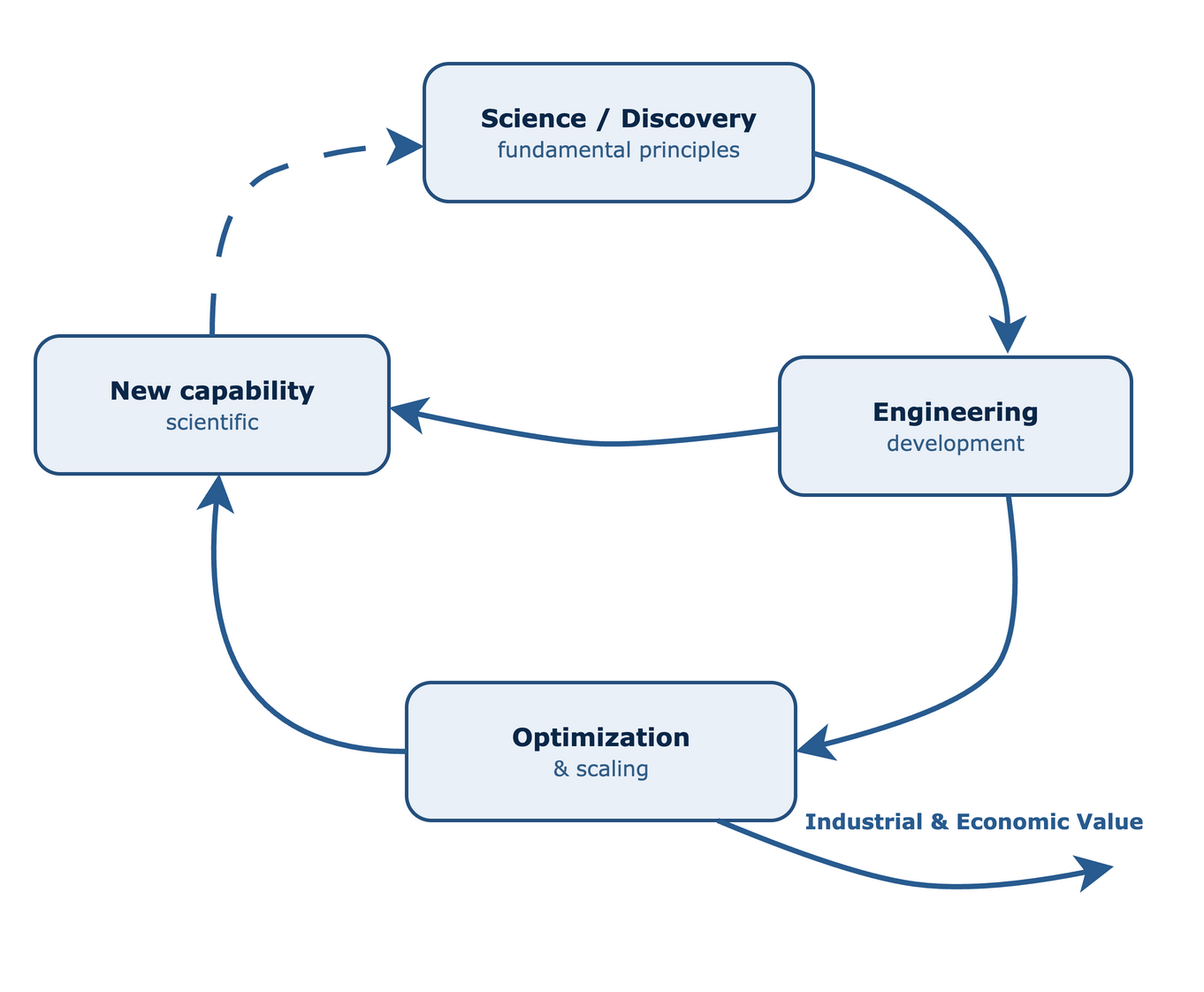
Discover develop optimize & scale cycle
A reinforcing cycle where discovery, development, optimization, and scaling convert knowledge into capacity and new societal value.
Discovery → Development → Optimization and scaling → New capacity
Yizhou Ma · Wageningen University
01 · The DDOs cycle
A reinforcing cycle of knowledge and capacity
Scientific discovery provides fundamental principles, while engineering and optimization translate those principles into capabilities that function under practical conditions.
The cycle becomes reinforcing when engineered capabilities support new experiments, which reveal principles that guide subsequent development and optimization.
01
Discover
Fundamental principles explain how a system behaves and identify mechanisms that could support new functions. This is science.
02
Develop
Engineering converts scientific theories and understanding into instruments, processes, models, or materials that operate and interact.
03
Optimize and scale
Optimization improves efficiency, while scaling makes volume effects visible across conditions, sources, and application contexts.
04
Enable
The resulting capacity supports new science, while optimized and scaled development creates routes toward industrial, economic, and broader societal value.
02 · A microbial cell factory
One cycle, viewed through microbial biomanufacturing
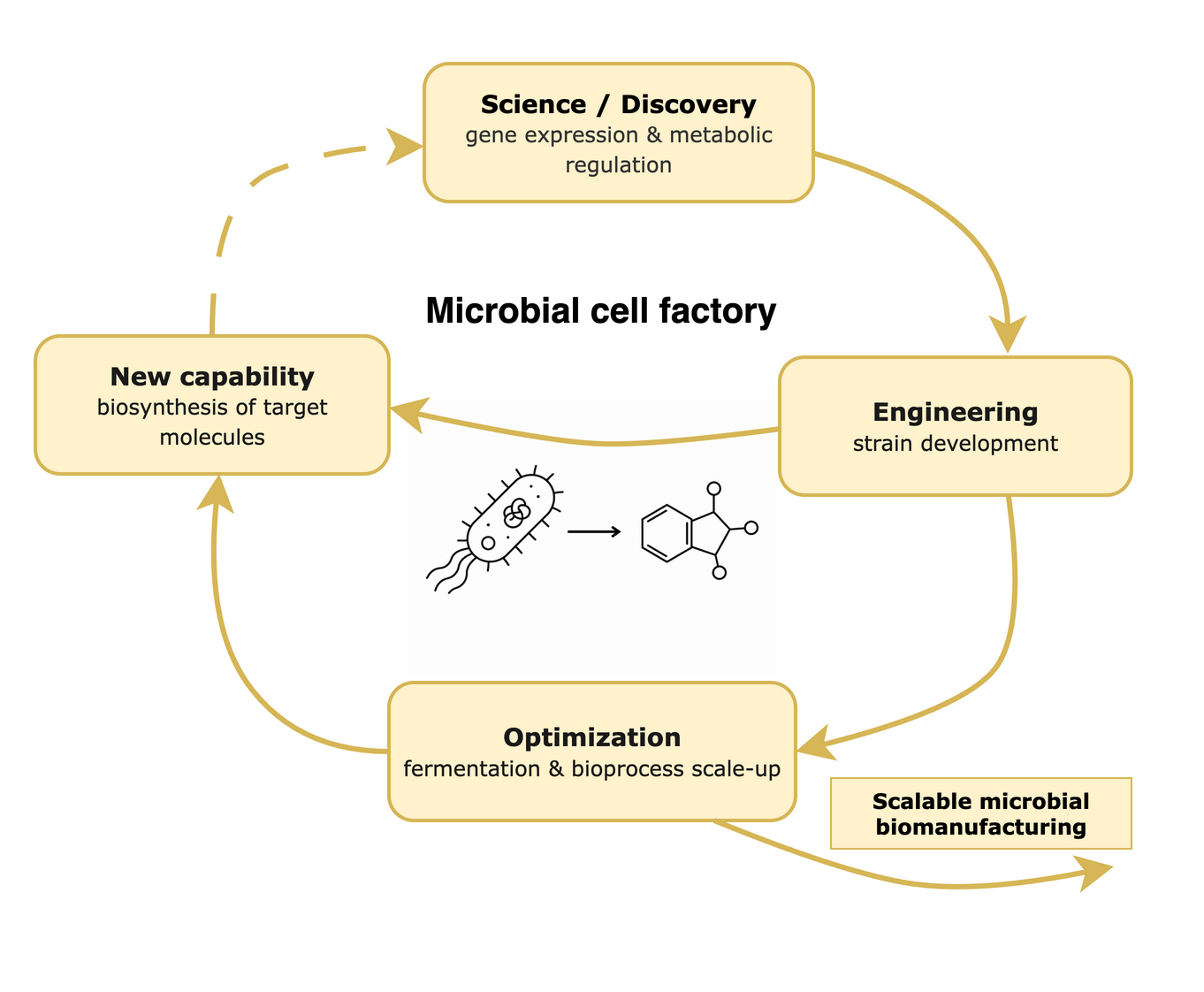
A microbial cell factory illustrates how molecular understanding can progress through strain engineering and bioprocess optimization toward scalable manufacturing.
Microbial biomanufacturing emerges through repeated exchanges between biological discovery, strain development, fermentation optimization, and the biosynthesis capabilities produced.
For science
Knowledge of gene expression and metabolic regulation guides strain development toward the biosynthesis of selected molecules.
Engineered strains then become experimental platforms for probing pathway constraints, regulatory responses, and previously inaccessible biological functions.
For society
Fermentation optimization and bioprocess scale-up determine whether biosynthesis can become reliable, efficient, and accessible beyond laboratory demonstrations.
Scalable microbial biomanufacturing can subsequently support new ingredients, materials, medicines, and production routes with industrial and economic relevance.
03 · Capacity gaps in food science
Capacity gaps in food science
These gaps concern the relationship between what instruments measure, what experiments reveal, and what predictive models retain across changing sources.
Development
The instrument–perception gap
Measurements should represent food properties in ways that agree with human sensory perception and remain useful for engineering decisions.
Optimization
Scaling out messy experiments
Food experiments involve variable materials and complex responses, requiring higher throughput without removing scientifically meaningful sources of variation.
Scaling
Extending the search space
Improved throughput expands the formulations and processing conditions that can be explored, creating opportunities for unexpected and transferable insights.
Optimization
Making predictive models generalize
Cross-source generalization determines whether predictive food models retain useful performance across ingredients, instruments, laboratories, and datasets.