AI for Food Science: The Landscape in 2025
A perspective on how modern AI models address food at molecular, product, and material scales, and where major gaps remain.
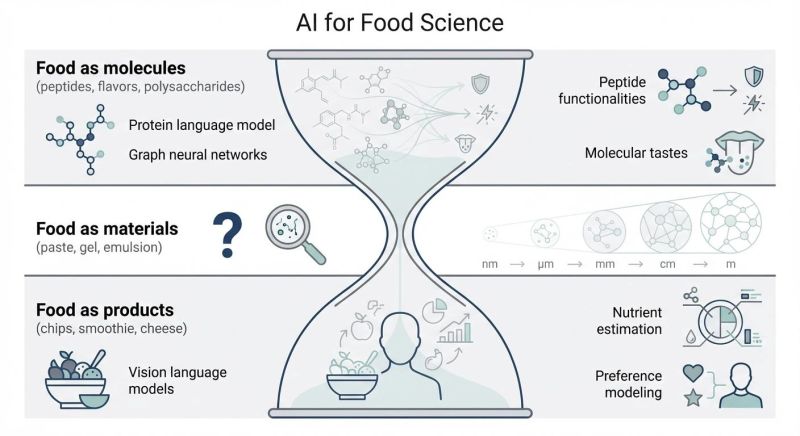
This project provides a structured perspective on how artificial intelligence is currently transforming food science and where major conceptual gaps remain. It examines three major abstraction levels: molecules, products, and materials. At the molecular level, large AI models such as protein language models and graph neural networks enable prediction of structure, stability, and functionality directly from chemical or sequence representations. These approaches support rational exploration of peptide functions, flavor compounds, and molecular taste mechanisms. At the product level, vision and vision-language models analyze food images and videos to estimate nutrients, portion size, and calories, while also enabling preference modeling, personalization, and quality assessment. In contrast, food as materials (pastes, gels, emulsions, and complex multiphase systems) remains underrepresented in modern AI pipelines. These systems are governed by multiscale physics, are highly process-dependent, and lack standardized representations and datasets. This work highlights the need for new representations and hybrid modeling strategies that connect molecules to products through structure and processing.