chemopls: an agent-native toolkit for PLS
An agent-native toolkit that makes partial least squares chemometrics reproducible, inspectable, and easier to apply.
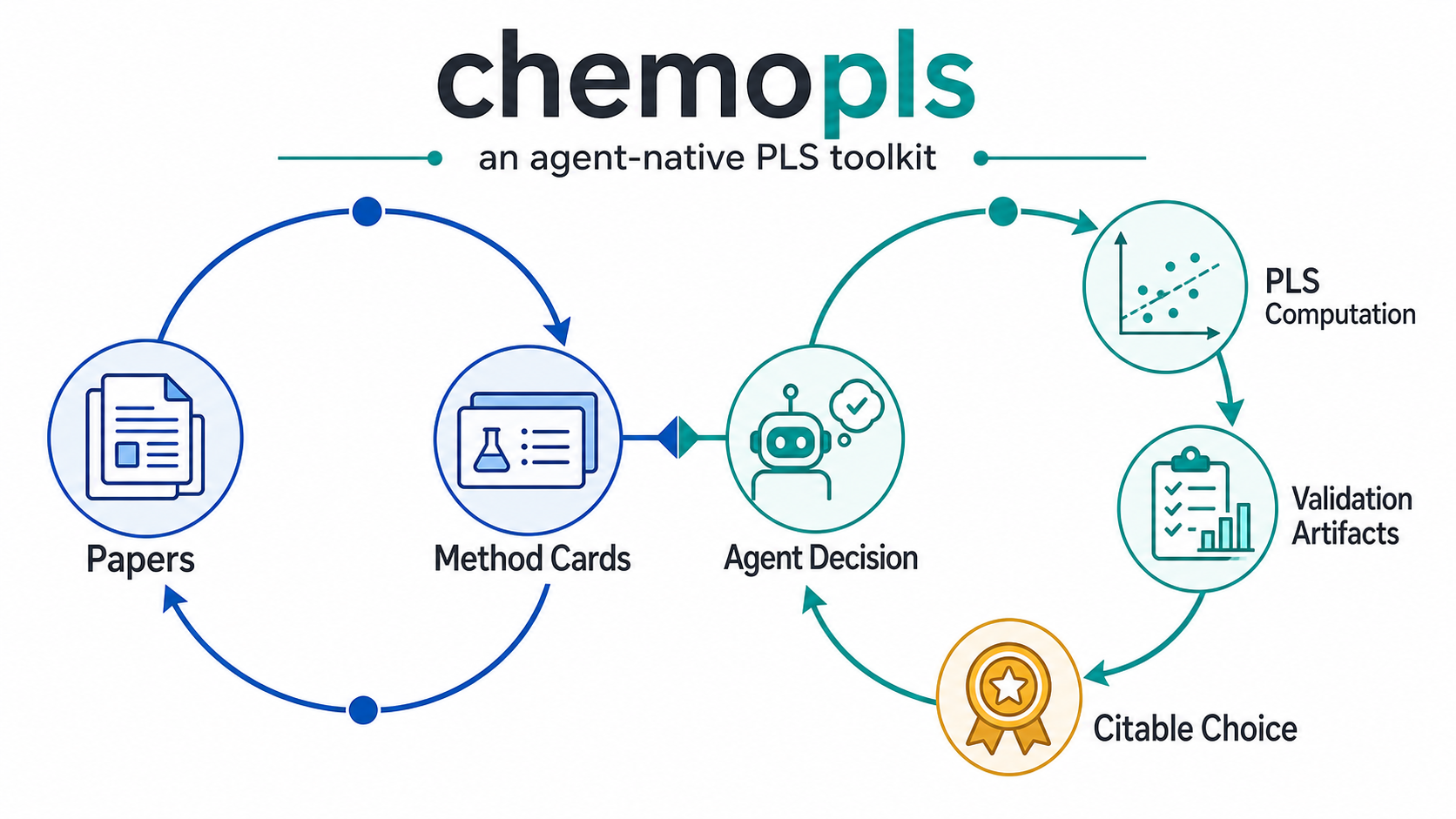
chemopls brings 20+ partial least squares (PLS) variants into one consistent Python toolkit. It supports PLS regression and PLS-DA-style classification through variable-selection, multiblock, and multiway variants, among others. It also includes agent-guided decisions on common spectral preprocessing steps within the same workflow. Many of these methods are reconstructed from the scientific literature: published equations, algorithm descriptions, and validation practices are translated into documented Python implementations, with method provenance retained so researchers can trace each implementation back to its source. The project is designed for collaboration between a researcher and an AI agent. The agent first inspects the dataset, checks its cleanliness, identifies the target type and predictor geometry, and recommends a suitable analysis harness. chemopls then performs deterministic preprocessing, modeling, and validation. Disclaimer: chemopls is currently an agent-preview package. Reconstructed methods should be reviewed carefully, and publication claims should rely on repeated, nested, or external validation.