Physics-Informed Neural Networks for Food Kinetic Modeling
Integrating physical laws with neural networks to improve prediction, generalization, and data efficiency in food kinetics.
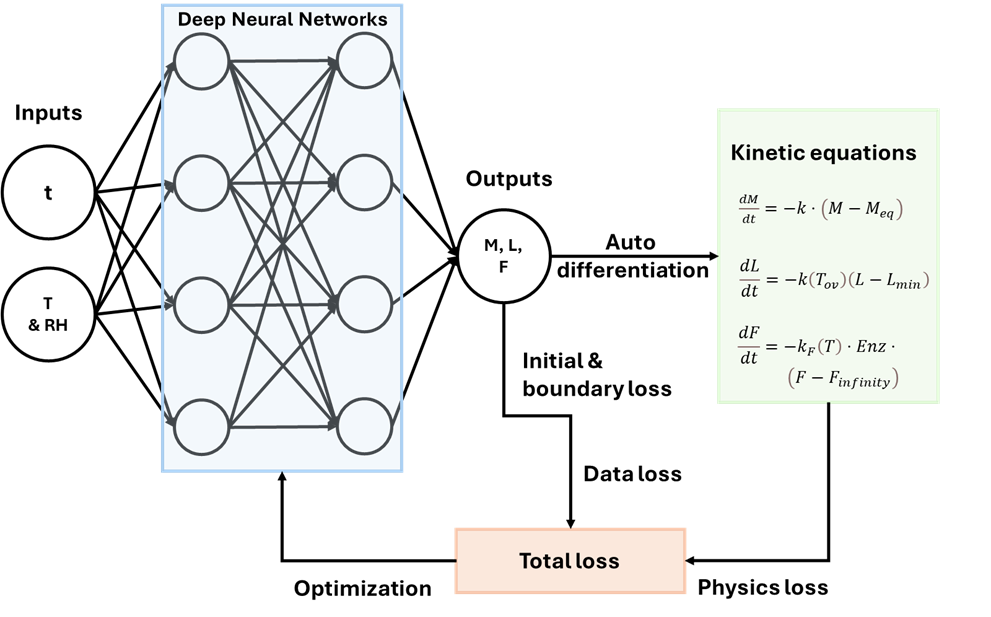
This project explores the use of physics-informed neural networks (PINNs) for modeling food quality kinetics during processing and storage. Traditional kinetic modeling relies on predefined equations, while purely data-driven models often struggle with extrapolation. PINNs combine both approaches by embedding known physical and kinetic relationships directly into neural network training. Using case studies in seed drying, bread baking, and kiwi softening, the study demonstrates that PINN models outperform empirical models in both interpolation and extrapolation tasks and achieve comparable performance to physics-based models when sufficient data are available. PINNs also support transfer learning, enabling efficient adaptation to new datasets with minimal retraining. The work highlights both strengths and limitations. PINNs show strong generalization and data efficiency, but challenges remain when handling discontinuities associated with multistage processing or abrupt transitions. Overall, the results position PINNs as a promising modeling framework for modern food kinetics, especially when data are limited but physical knowledge is available.