Funded project review
Alternative fats: non-lipid replacers, plant fats, and biotechnology
Funded alternative-fat research spans protein-based replacers, structured plant lipids, fermentation, and cultivated fat.
Non-lipid replacers · Plant fats · Biotechnology
Yizhou Ma · Wageningen University
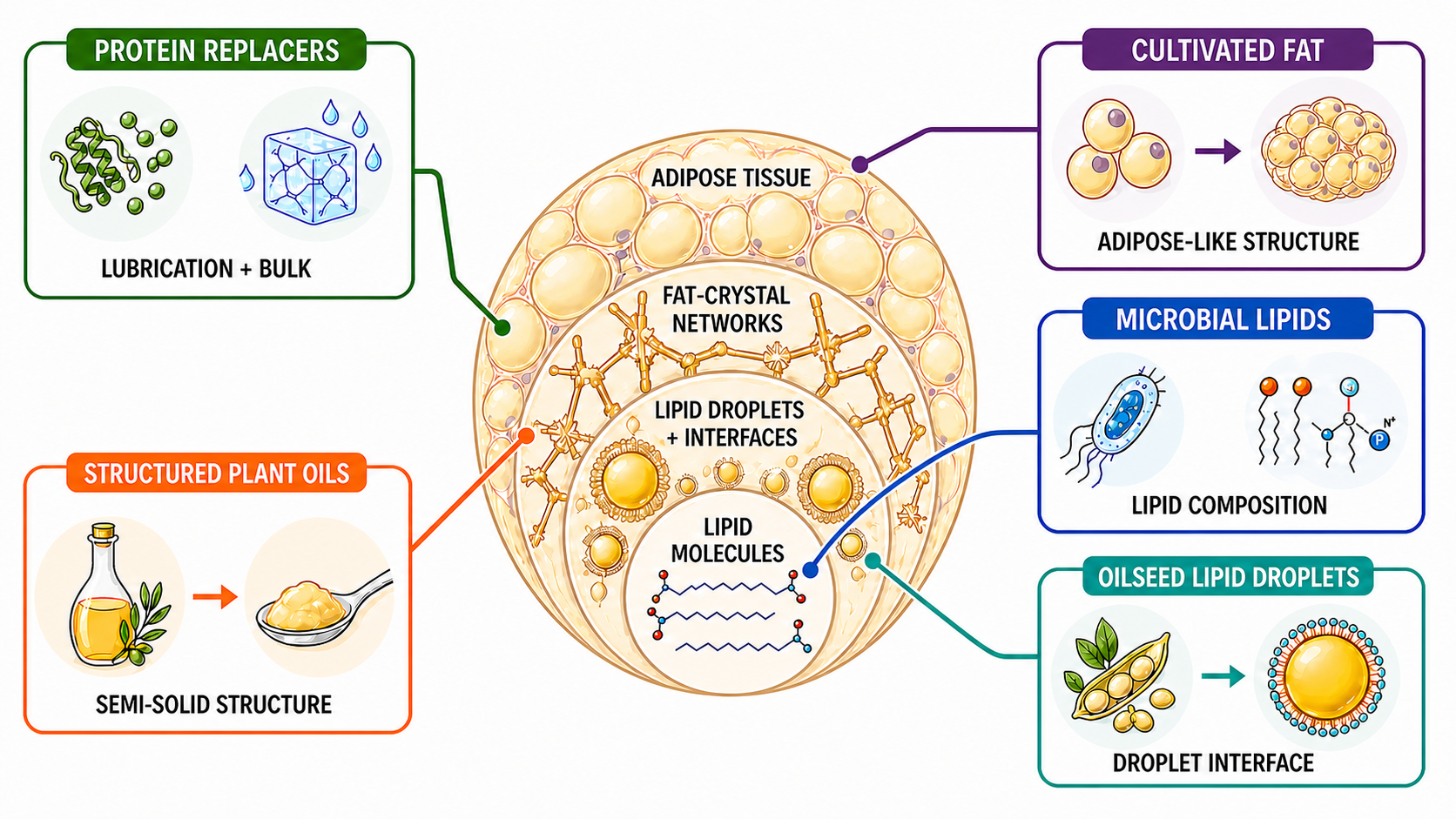
Fat plays a lot of roles in food. It can be a dispersed droplet that makes a dairy product creamy, a crystal network that keeps chocolate or a spread solid, or adipose tissue that gives meat its juiciness. Removing fat is very difficult, but due to the negative (and sometimes not so true) health claims, there is a constant pursuit of removing fat from food. Reviewing the funded projects, I found three different layers to achieve this goal. Proteins can take over selected physical functions while reducing the lipid fraction in food formulation. Plant oils can remain as lipids but be reorganized into more useful structures that resemble animal fats. Fermentation and cell cultivation can produce new biological sources of lipids or fat-like material. These projects are all described as alternative-fat research, but they are not trying to make the same thing.
Replacing fat functionality with proteins
The most direct way to reduce fat is to ask another ingredient to do part of its job. In this route, a hydrated protein phase may supply thickness, water retention, lubrication, or a soft particulate structure. It does not become a new lipid. The formulation instead redistributes responsibility from fat droplets and crystals to proteins dispersed in water. For example, a USDA NIFA project on hydrolyzed plant-protein aggregates as fat replacers in fat-free dairy foods makes this route very clear. Its target is a dairy matrix in which removing fat normally creates a stiff or less creamy product. The Purdue group behind the project has previously used pea-protein aggregates to soften fat-free cream cheese, so the funded work has a very specific food application rather than a generic protein-functionality goal.
A German project on microparticulated plant proteins as fat substitutes works at a different structural scale. Microparticulation creates small, deformable protein particles that can move past one another and imitate part of the smooth mouthfeel of fat. A Canadian project moves from droplets to solid networks. Self-assembled low-molecular-weight protein crystal networks are intended to replace traditional fat-crystal networks in processed foods. The target is not simply creaminess. Fat crystals give many products mechanical strength and temperature-dependent behaviour, so the replaced network must hold the food together without behaving like a rigid protein gel.
While carbohydrates used to be the go-to for fat replacement, I did not find a direct title-level project that focuses on carb-based fat replacers. That absence highlights the overall research interest on food proteins. The overarching impacts of these projects are very straightforward about fat reduction. The intention is well-suited for public research, and the fat-replacement-to-sensory gap is yet to be filled.
Substituting animal fat with structured plant lipids
The second route keeps fat as fat. It follows the plant-based food transition. Rapeseed-oil oleogels for improving the fatty-acid profile of deep-fried foods convert a liquid plant oil into a semi-solid material through oleogelation. Here, the nutritional target is not necessarily less total fat but a more sustainable fat source. Perfat Technologies brings the same general logic closer to commercialization. The Business Finland-supported company structures vegetable oils using an oleogel technology reinforced with dietary fibre, aimis to replace solid fats such as butter or palm oil across several food applications. Both examples begin with an available plant oil and rebuild the solid-like functionality that normally comes from animal/deforestation-causing sources (i.e. palm).
Two Dutch projects start one structural level earlier. HARMOny, Harvesting Milk Fat Globules from Oilseeds, asks whether native plant lipid droplets can provide structures resembling milk fat globules. Oilseeds already package lipids inside droplets with biological surface layers, and the project aims to use those structures in plant-based dairy. A related project studies the functionality of milk fat globule membrane ingredients and their plant-based alternatives. This comparison shifts attention from the triglyceride core toward the membrane materials around it. Recovery and interface stability may then be as important as choosing the oil itself.
These plant-lipid projects replace the source and organization of fat rather than removing the lipid phase. Oleogels rebuild a semi-solid network after oil extraction, while biological droplet architecture can be preserved through careful colloidal designs. This level of fat alternative drops the health high ground but focuses more on responsible fat sources (also cool, but takes longer to explain impacts).
Biotechnology creates new lipid sources at two different depths
You cannot browse through food grants in 2026 without reading about biotechnology. Alternative fats are made through fermentation. The Singapore Food Agency-funded Alternative Lipids project uses precision fermentation to produce omega-3 polyunsaturated fatty-acid-enriched phospholipids for alternative protein foods (what a month-full). This is a selected nutritional lipid rather than a complete fat structure, but it is high value enough for precision fermentation. A Norwegian project on AI-controlled fermentation for microbial lipid production puts the process itself at the center to produce lipids. The immediate problem is how to steer yield and composition consistently, after which recovery and oxidation stability still have to be handled.
Cell cultivation goes deeper into the original biological structure. A Singapore project develops a scalable and versatile platform for cultivated-fat production. Rather than producing a chosen lipid molecule, it aims to cultivate cells that accumulate lipids and form fat-like material. This could provide adipose-like domains for cultivated or hybrid meat, achieving the spatial distribution of fat matters for juiciness and flavour release. It is clear that biotechnology is capable of producing various forms of lipids. There is a cost hurtle to overcome, very obvious and hard to avoid.
A fat system has several possible replacement depths
The funded projects do not point toward one universal alternative fat, and I do not think they should. Fat systems are a great playground for physical chemists because every layer introduces new and interesting complexities. Lipid composition, droplet interfaces, crystal networks, and even adipose organizations all have great scientific depth.
Alternative fat is underfunded compared to alternative protein research. A simple title search in this database found 74 projects mentioning protein, compared with 10 projects directly describing alternative fat. Although this is not a comparison of total funding, the imbalance is still large enough to show where the research attention has accumulated. Even several fat projects are using proteins... The alternative-fat portfolio is thinner and more fragmented across colloid science, lipid crystallization, fermentation, and cell culture.
This could be a result of limited impact. Fat is scientifically complex but somehow not as grounded in impact compared to protein, fermentation, valorization, and (definitely) food safety. If a future diet increases protein consumption substantially, where would we cut calories, and how much would it come from fat? The answer would affect whether we need fewer fats, different fats, or new fat structures for alternative foods. It seems like the impact pathway lacks some collective narrative moving forward... Perhaps researchers in this field are soul-searching, just like all of us.
Representative funded projects
| Route | What is replaced? | Replacement material | Main food function | Representative project | Main limitation |
|---|---|---|---|---|---|
| Protein-based fat replacement | Part of the lipid phase | Hydrolyzed aggregates or microparticulated protein | Lubrication, creaminess, and water retention | USDA plant-protein fat replacer and German microparticulated proteins | Off-flavour, particle size, and matrix compatibility |
| Protein crystal-network replacement | Fat-crystal network | Self-assembled low-molecular-weight protein crystals | Solid-like structure | Canadian protein crystal-network project | Temperature response and food-matrix compatibility |
| Plant-oil structuring | Animal or saturated solid fat | Oleogelated plant oil | Semi-solid structure and oil binding | Rapeseed-oil oleogels and Perfat Technologies | Heat stability, sensory texture, and scale |
| Biological droplet recovery | Animal-fat globules and interfaces | Oilseed lipid droplets or plant membrane ingredients | Interfacial functionality | HARMOny and milk fat globule membrane alternatives | Recovery, interface stability, and batch consistency |
| Microbial lipid production | Selected conventional oils or nutritional lipids | Fermented fatty acids or phospholipids | Lipid composition and nutritional delivery | Alternative Lipids and AI-controlled microbial lipid production | Fermentation control, recovery cost, and oxidation |
| Cultivated fat | Animal adipose tissue | Differentiated animal cells | Tissue-like fat domains | Singapore cultivated-fat platform | Media, differentiation, harvesting, and scale |
Data note
The analysis used project titles and reviewed descriptions from the merged grant database. The assigned theme, country, and year were not used to construct the categories. The count of protein and alternative-fat projects is a title-level comparison rather than a complete funding analysis. Award amounts were not compared because they are missing or not directly comparable across many records. Project pages describe funded aims, and those aims should not be read as completed technical outcomes.