Funded project review
Two alternative protein routes: plants for bulk and fermentation for function
Plant proteins provide bulk and physical structure, while precision fermentation supplies selected proteins with targeted functions.
Plants for bulk · Fermentation for function
Yizhou Ma · Wageningen University
Two alternative protein routes: plants for bulk and fermentation for function
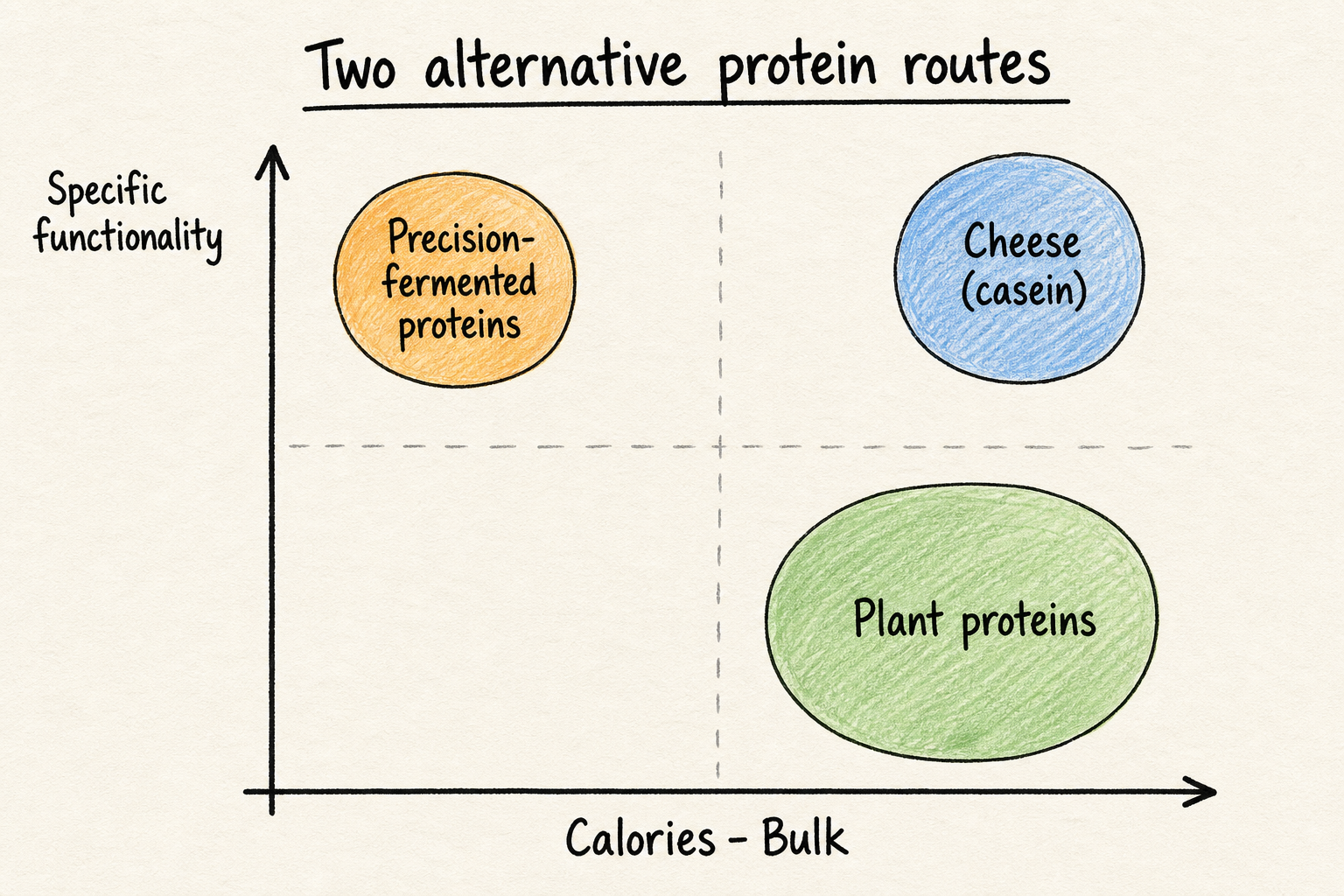
Proteins have many roles in food. They provide calories and are essential functional ingredients in modern foods. It is no surprise that food protein research continues to dominate funded research projects. The primary focus of these projects is to explore more sources of protein. Reviewing recently funded projects, I found a useful division. Plant proteins are mainly being developed as the bulk protein and physical base of foods, while precision fermentation is being used to make selected molecules with targeted functions. Plant protein research is also moving into very targeted topics, with less focus on "if we can" and more on "how we can" (further increasing the TRL of such ingredients).
Plant proteins: bulking is also a function
Plant-protein extraction no longer just focuses on increasing yield. Extraction of plant proteins has become very targeted, with specific applications in mind. It is clear that the ongoing projects are moving beyond protein purity in a composition table. Food ingredients need to have a clean taste and still dissolve and gel well. For example, PROTSENS studies how extraction conditions shape sensory properties, treating flavour as an outcome of processing rather than a defect to hide later. Another USDA project combines ultrasound and fermentation for pulse-protein fractionation, aiming to obtain functional fractions without relying on one harsh separation step. ProPulse takes a related route. It combines dry fractionation with sourdough fermentation to reduce beany flavours and antinutritional factors in mildly refined pulse ingredients. NutriRaps makes that trade-off explicit by comparing rapeseed fractions across nutrition, sensory quality, processing, environmental impact, and cost.
The next focus is the food matrix. Plant proteins are heterogeneous fractions, and the funded work reflects and embraces this complexity. An Australian project studies network-forming behaviours of plant proteins, while the Dutch MIPRODESIGN project combines microfluidics and modelling to accelerate plant-protein emulsion design. Three Canadian projects show this matrix-level focus. One studies starch–plant-protein interactions, another uses protein–polysaccharide phase separation to create aqueous two-phase systems and water-in-water emulsions, and a third investigates how to tailor the interfacial behaviour of plant proteins. Together, they cover three structural levels: interactions with starch, organization into separate aqueous phases, and protein behaviour at food interfaces.
Plant-protein projects also increasingly finish with recognizable products. A Vinnova-funded project is developing chickpea protein isolate as an egg replacer, which requires the ingredient to reproduce several egg functions rather than simply add protein. A USDA project uses hydrolyzed plant-protein aggregates as fat replacers in fat-free dairy foods. Another project develops 3D-printed plant-protein foods, where flow, shape retention, and final texture must all work together.
It is clear that everyone wants to use more plants as foods. The impact pathway concerns the protein transition, sustainability, and animal welfare. It remains a well-positioned research topic with increasingly clear goals: plant proteins provide protein mass, nutritional energy, and physical body to foods. They are not functionless in the sense of being merely "bulking" ingredients. In fact, the projects show how much work is required to make consistent bulk proteins for food applications.
Precision fermentation: minor in weight, major in functions
Precision fermentation produces very targeted protein molecules, often from animal-associated origins. Here, the exact functionality of animal proteins can be reproduced through an animal-free route. With a clear target, this becomes an engineering problem of optimizing precision-fermentation tools for food applications. For example, Bioalbumen scales fungal production of ovalbumin, the main egg-white protein responsible for much of its ingredient performance. HYDROCOW engineers hydrogen-oxidizing bacteria to convert carbon dioxide into the whey protein beta-lactoglobulin. At a more biofunctional level, HuMiLAF produces human lactoferrin for infant formula and immunity products. These projects range from food structure to targeted nutrition, but all depend on making one selected protein reliably. These proteins aim for molecular-level purity, offering predictable physicochemical or nutritional functionality.
Feedstock flexibility is one of the most interesting possibilities here. This is one aspect of precision fermentation that many "outsiders" criticize, particularly feedstock origin and price. The UPCYFUN project combines optimized fungal strains with upcycled bio-residuals to make animal proteins. From Air to Food is building shared capacity for gas-based precision fermentation, while another European project targets carbon-dioxide-based production of functional food ingredients. Biotechnology can partly separate the choice of protein from the choice of carbon source, making the whole process more ecologically justifiable. The useful point is that biotechnology opens feedstock options that animals and crops do not, while leaving plenty of process engineering to do.
Producing the correct sequence is also not the end. Bioalbumen still has to deliver egg-like ingredient performance, while HuMiLAF includes property validation and testing in standalone and co-encapsulated forms. A Singapore Food Agency project examines allergenicity and immunotoxicity by looking at covalent modifications in precision-fermented proteins. These projects move the field toward higher technology readiness because they incorporate immunotoxicity and food safety into the design process. This will surely become a growing field of research, perhaps led by experts in toxicology and medicine.
Precision fermentation holds an interesting role now. It is technologically very advanced, which is itself worth the scientific pursuit. It is also an area that private capital prefers, which makes it interesting for public funds to co-invest. The impact pathway focuses clearly on high-quality proteins and their functionalities.
The two routes can meet in cheese
Plant proteins and precision-fermented proteins may compete for research funding, so it makes sense to write a project proposal that covers both aspects. A plant fraction can provide most of the protein and matrix body, while a smaller amount of a selected molecule supplies key functions. Examples include hybrid projects such as FlavourFerm, which aims to use precision-fermented recombinant casein in plant-based milk and cheese. PLANTOMYC combines plant proteins with mycelium protein biomass from circular substrates to make hybrid meat analogues. The second project uses biomass fermentation rather than a purified precision-fermented molecule, but the formulation logic is similar: let different protein sources do the jobs they are best suited for.
Cheese is the awkward exception to the bulk-versus-function distinction. Casein has highly specific functions, but it is also needed in large amounts in cheese. This makes cow-free cheese a demanding test. FungCows must produce casein efficiently enough to support cheese manufacture. FUNCAS must recover it without losing the required functionality. FlavourFerm then places recombinant casein into plant-based milk and cheese at pilot and pre-commercial scales. Precision fermentation is attractive because casein is difficult to replace, but the process must deliver molecular precision at something closer to commodity volume and cost. That is quite a technical challenge, but certainly one with a high reward.
Different proteins, different jobs
| Protein route | Representative funded projects |
|---|---|
| Plant proteins | PROTSENS; ultrasound- and fermentation-assisted pulse-protein fractionation; ProPulse; NutriRaps; MIPRODESIGN; network-forming behaviours of plant proteins; chickpea protein as an egg replacer; 3D-printed plant-protein foods |
| Precision-fermented proteins | AI-assisted production of milk proteins; Bioalbumen; HYDROCOW; HuMiLAF; UPCYFUN; FungCows; FUNCAS; milk-free recombinant osteopontin |
| Hybrid protein systems | FlavourFerm; PLANTOMYC; YarroPro |
Data note
This analysis uses project titles and reviewed descriptions from the merged grant database. The links describe funded aims rather than completed outcomes, and the categories show emphasis within this collection rather than the complete global funding landscape.