Funded project review
A process for all: fermentation in food biomanufacturing
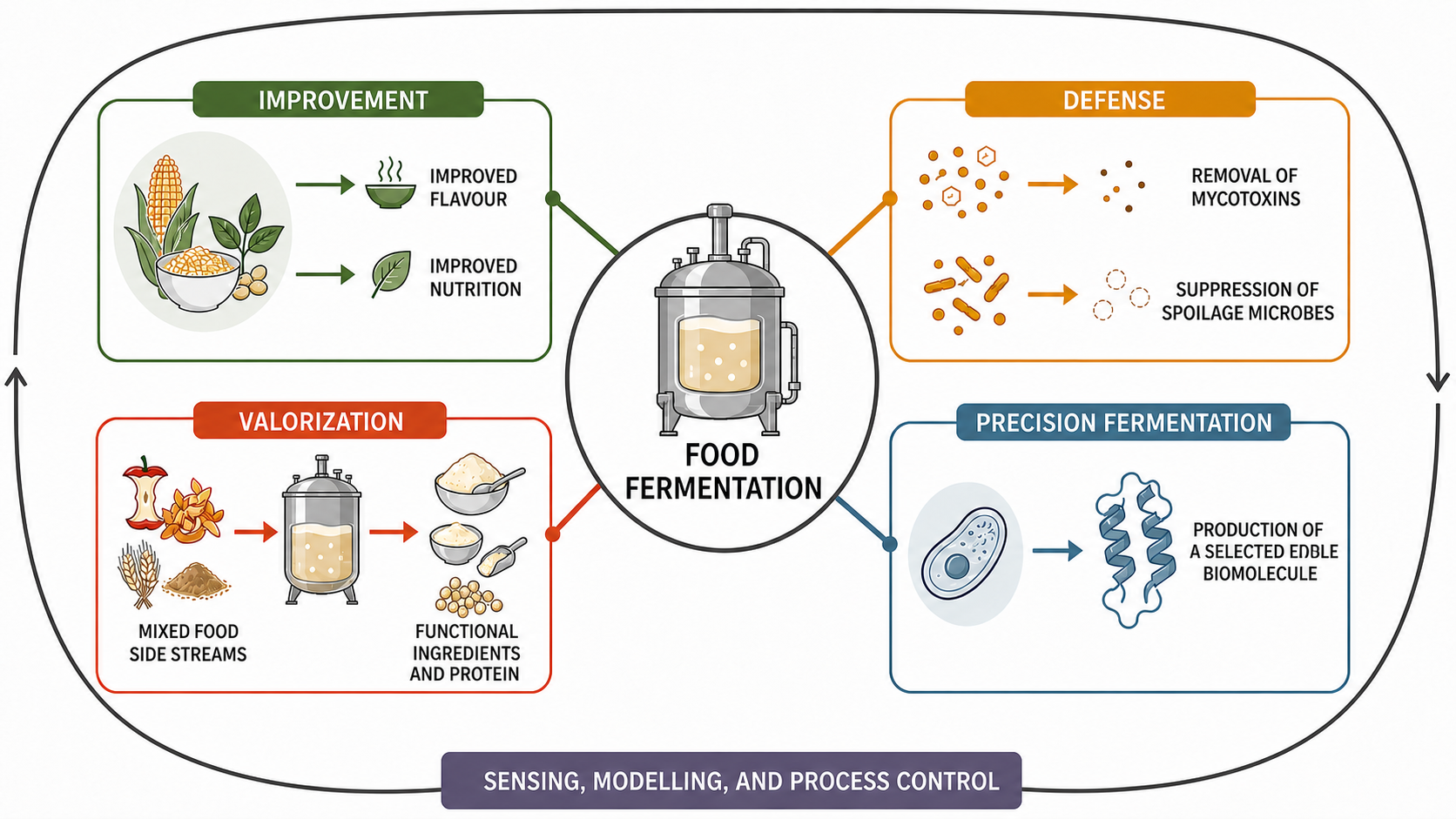
Fermentation as a complex bioprocess covers many different subfields within food science.
Improvement · Defence · Valorization · Precision fermentation
Yizhou Ma · Wageningen University
Fermentation has a long history as a cooking and preservation method. Bread, yoghurt, beer, and many fermented foods have provided its most familiar forms for hundreds of years. Fermentation as a biotechnology has been emerging, and its research questions extend well beyond conventional fermented foods. Upon reviewing the funded projects, very few of them study fermentation as an isolated process. More often, fermentation uses microbial activity to achieve specific targets in foods such as improving a food property or controlling a hazard. Other fermentation projects valorize residual biomass or produce a selected biomolecule through precision fermentation. Here, I try to group fermentation projects and you can see how fermentation as a complex bioprocess covers many different subfields within food science.
Fermentation as a biochemical improvement step
Many plant ingredients already contain sufficient amounts of protein and carbohydrates, but their quality in general does not match that of animal-source counterparts. For example, antinutrients such as phytic acid are present in legumes, and many plants carry unwanted off-flavors. Fermentation offers a targeted improvement step. Microorganisms can consume an unwanted compound or release a useful one within the original food matrix.
A major improvement target is flavor, especially removing bad flavors from plants and adding pleasant flavors through fermentation. A European project on microbial fermentation products for plant-based dairy addresses flavour, odour, and texture together. These attributes determine whether a plant matrix resembles the expected dairy product. Another European project focuses specifically on releasing flavour potential in plant-based foods. The target focuses on producing sensory compounds within plant-based foods to improve consumer acceptance. One more, a GFI-funded project uses Basidiomycota with Allium species to produce meat-like umami and kokumi flavors for plant-based meats.
Fermentation also generates flavor in drinks such as coffee. A Swiss project studies extended post-harvest fermentation for coffee quality. Here, the raw material is familiar, but the fermentation process window becomes the design variable. Fermentation can also generate flavors from unfamiliar sources. One Danish project applies coffee-like fermentation to chicory beverages to develop aroma in a caffeine-free matrix.
Fermentation can also improve nutritional quality, again for plants. The EAA project aims to bring fermented plant-based dairy closer to the amino acid profile of milk. The project searches plant-derived lactic acid bacteria using droplet microfluidics and adaptive laboratory evolution. Sequencing and bioinformatics support the search for strains that improve nutrition without sacrificing flavor. VegVit addresses another limitation of plant-based alternatives, targeting vitamin B12 improvement through fermentation. NutriFood combines phytase activity with postbiotic production. Phytase can reduce phytate, which otherwise binds minerals and limits their bioaccessibility.
In addition, fermentation can be a processing step for plant materials. For example, a USDA NIFA project (1032496) combines ultrasound and fermentation to recover pulse proteins with improved quality and functionality. Fermentation may loosen the surrounding cellular matrix before separation. The proposed benefit is gentler fractionation rather than maximum protein yield at any cost.
The term "improvement" can aim for flavor, nutrition, and processing efficiency. The food matrix sets the problem scope and the microorganism supplies a biochemical route to hopefully achieve these targets. The impact of these projects is well-grounded and directly addresses grand challenges such as protein transition and improving human health.
Fermentation as a biochemical defence step
Biochemical selectivity based on fermentation can also protect food from harmful microbes and toxins. This is a direction that makes total scientific sense to me, but I never thought of. Fermentation organisms may suppress competitors, produce antimicrobial compounds, or transform a stable contaminant into harmless compounds. RETOX-PRO provides the clearest example. The project screens microorganisms that can remove mycotoxins during solid-state fermentation of faba beans and other legumes. Another interesting project comes from Brazil. The stingless-bee honey project searches a naturally fermented food for biopreservative compounds and potential probiotics. The fermented ecosystem becomes a source of protective functions. Researchers first identify organisms or compounds in the ecosystem, then assess whether they can protect another food.
Not every microbial interaction is beneficial. A Swiss project examines persistent phage infections in traditional food fermentation. Phages can destabilize starter cultures and change fermentation outcomes. Reliable fermentation therefore requires control over the unwanted biology as well as the desired microorganisms. An Austria-Nigeria collaboration studies underutilized fermented foods through sensory quality, functionality, and safety. Food defence therefore includes more than pathogen removal. Fermentation can remove a chemical hazard or generate a preservative for natural foods.
The defensive mechanisms of fermentation can cover detoxification and food biopreservation (which has been one of the original purposes of food fermentation). This research direction scientifically examines the old practices with novel approaches for plant-based and indigenous food fields, again with very good societal impacts.
Fermentation as a route for side-stream valorization
Valorizing food side streams and wastes is a very conscience-resonating direction of research. Waste streams contain fermentable substrates that can be converted into functional ingredients and proteins.
A lot of the waste streams are not in liquid states, so solid-state fermentation is often experimented with. A European project uses solid-state fermentation to convert production side streams into multifunctional ingredients. Solid-state systems can process moist solids without first creating a dilute liquid feed. UPCYFUN combines bio-residual feedstocks with optimized fungal strains. Its target is an animal protein produced through precision fermentation. Another project builds a Scottish biofermentation hub around brewery waste to make bakery products. Another project from the UK also connects control and processing aspects of fermentation based on AI optimization using side-stream valorization as the application.
The most fun example I found is the BreadFerm project. This project develops baking ingredients from leftover and returned bread. Its project description reports about five million tonnes of baked goods produced annually in Germany. Roughly one-third is reported as lost. BreadFerm aims to ferment part of this stream back into an ingredient suitable for baking. This also reminds me of reworking extrudates by extruding the "trial samples" again to make the finished product.
Here, a lot of the prior applications can be potentially combined with valorization. It will be great if fermentation can "turn shit into gold". These are projects with a very clear impact pathway.
Precision fermentation: edible biomacromolecules are not necessarily food (yet)
Precision fermentation produces a selected biomolecule rather than a complete food matrix. Simply put, precision fermentation makes production of biomolecules programmable through strain development. The substrate in precision fermentation is normally not food, and the target molecule coming out of the fermentation is normally an edible biomacromolecule (also known as an ingredient), not a food, yet. This makes the whole process a bit distant from traditional food production, making this a nice angle for interdisciplinary studies that grant agencies promote. Another note: strain development is often not funded by food grants. In the general bioprocessing context, food applications are either fermentation optimization and/or downstream processing.
In the context of food, generally the target molecules are highly bio-functional and nutritious compounds such as milk casein proteins. The food-related projects tend to focus on substrates, process control, or target molecule production. A very popular target molecule is milk protein. Several projects focus on various approaches to making casein through precision fermentation. For example, FUNCAS examines how microbial caseins can be isolated without losing their food functionality. Many other milk-protein-producing projects are now nearing completion, too. Several other edible biomolecules include tagatose and omega-3-enriched phospholipids. These projects are refreshing after seeing a number of precision fermentation projects targeting milk proteins.
Another interesting aspect is the substrate. It seems like we have ways to make valuable biomacromolecules, but they are expensive to produce as foods. The desire is to use cheaper, environmentally friendly feedstocks such as gas. For example, gas-based precision fermentation and carbon-dioxide-based production of functional ingredients are two large EU projects that were recently funded. Another project is a double-dip on this list: UPCYFUN aims to produce animal protein with optimized fungal strains and upcycled bio-residuals. These projects reconsider substrate origin, which supports the goal of "advancing technology without compromising planetary boundaries" (very European).
The engineering layer around fermentation
The four research directions of fermentation share one constraint. Microbial behaviour must be measured and controlled well enough to deliver a consistent fermentation result. Fermentation is a process that can be monitored, simulated, and optimized for the good intentions listed above. For example, several projects move sensing directly into the fermenter. A United States project develops wireless free-floating microbial-electronic sensors to collect data from within an active vessel. EpiFerm maps DNA methylation in starter cultures. The project asks whether epigenetic information can explain fermentation performance that sequence data alone may miss. MiKI and AI-optimized fermentation combine metabolic analysis and sensing with artificial intelligence for process control. These approaches address different parts of the same search problem. Researchers need to find a suitable strain, understand its state, and maintain its performance during processing.
Representative funded projects
| Research role | Correction target or output | Representative project | Funder or programme |
|---|---|---|---|
| Sensory correction | Flavour, odour, and texture in plant-based dairy | Microbial fermentation products | European Commission |
| Nutritional correction | Essential amino acid profile | EAA | Plant2Food |
| Nutritional correction | Vitamin B12 in plant-based alternatives | VegVit | German industrial research programme |
| Flavour creation | Umami and kokumi flavourings | Basidiomycota and Allium fermentation | Good Food Institute |
| Food defence | Mycotoxin removal from legumes | RETOX-PRO | Plant2Food |
| Food defence | Biopreservatives from fermented honey microbiota | Stingless-bee honey project | FAPESP |
| Valorization | Functional baking ingredients from returned bread | BreadFerm | German industrial research programme |
| Valorization | Protein from food side streams | AI-optimized fermentation | United Kingdom ISPF |
| Precision fermentation | Functional ingredients from carbon dioxide | CO2-based precision fermentation | European Commission |
| Process control | In-fermenter microbial-electronic sensors | BioMADE sensor project | United States NSF |
Data note
The analysis used project titles and reviewed descriptions from the merged grant database. The assigned theme, country, and year were not used to determine the research categories. All projects are ongoing or recently funded. The article therefore describes research objectives rather than completed technical outcomes.